A course about who belongs, built so that everyone in it belonged
United Nations Development Programme · Diversity, Inclusiveness and Women in Leadership
They were not looking for slides
UNDP wanted eLearning on promoting gender parity, diversity and inclusiveness in the UN workplace.
What they asked for was specific, and it is worth quoting the shape of it. They wanted a vendor who would use the current tools to add meaning and value to self-paced courses. Gamification, interactivity, animation, and voiceover in particular languages.
That is not a request for a course. It is a request for something people will actually finish, on a subject most organisations deliver as a policy document and hope nobody asks about.
What the courses had to do
The outcomes were set by UNDP, not by us, and they were unusually demanding for self-paced learning.
Build the skill and the confidence to act as a change agent for gender-inclusive leadership. Manage diversity consistently rather than once. Articulate the business case for women in leadership. Understand which dimensions of diversity actually affect how a team performs.
Note what is missing from that list. Nobody asked for awareness. They asked for people who could do something differently on Monday, which is a much harder brief and a much better one.
The decision the subject forced on us
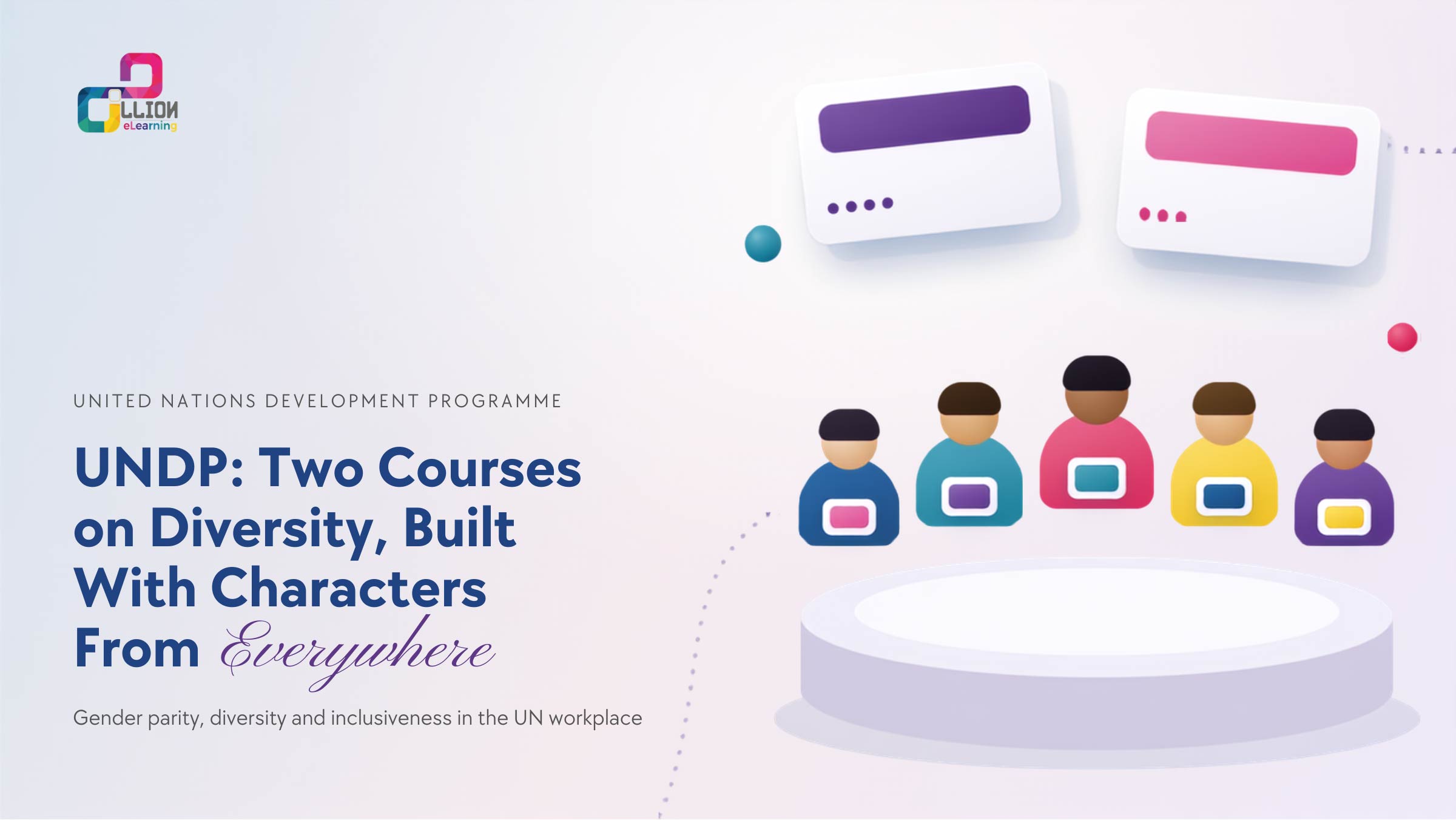
The characters in a course about diversity cannot all look the same.
It sounds obvious written down. It is skipped constantly, because stock character sets are cheaper and faster and nobody in the review meeting notices.
We designed separate characters from different cultures and countries, across both courses. Not as decoration. A learner in one region who never sees anyone like themselves in a course about inclusion has already been taught something, and it is not what the course intended.
Everything else followed from the same logic. Business cases were embedded inside the modules rather than bolted on at the end, so the argument was made in context. Learners were challenged with questions partway through and again at the close. They were told at the start to aim for the full hundred, which turns a compliance obligation into something with a score attached.
Built in Articulate Storyline, to UNDP and UNSSC branding guidelines, which had to agree with each other on every screen.
Diversity and Inclusiveness ran to four modules. Women and Leadership, three.
Average length thirty to forty minutes. Self-paced, interactive, with a points system running through.
The interface was built to explain itself. On a course that people take alone, at their desk, in a second or third language, the navigation is part of the instruction whether you designed it that way or not.
What happened
UNDP saw understanding and participation rise. Employees were clearer on the objectives of diversity and inclusiveness, and on gender parity, and they used what they had learnt in their own roles across their regions.
Registrations on both courses increased. Participants told UNDP the courses mattered. The feedback survey turned up no technical faults in any module, which sounds like a small thing and is not: a broken interaction in module three is the most common reason a good course is abandoned.
We do not have a completion percentage for this programme and we are not going to estimate one. What we have is what the client reported, and that is above.
What we would tell someone in the same position
What we would tell someone building this course
If you are producing training on diversity, inclusion or anything about how people treat each other, look at your character set before you look at your script. The people in the course teach as much as the words do. And put the assessment inside the content rather than at the end, because on this subject the moment of learning is the moment somebody realises a scenario applies to them.
The offer, stated plainly
Tell us what training you have to deliver this year. We will map it with you, free, and say honestly which parts you already have covered and which parts you do not need us for.
Zillion eLearning · 12 Ataturk Avenue, F-6/3, Islamabad · +92 (321) 955 9599